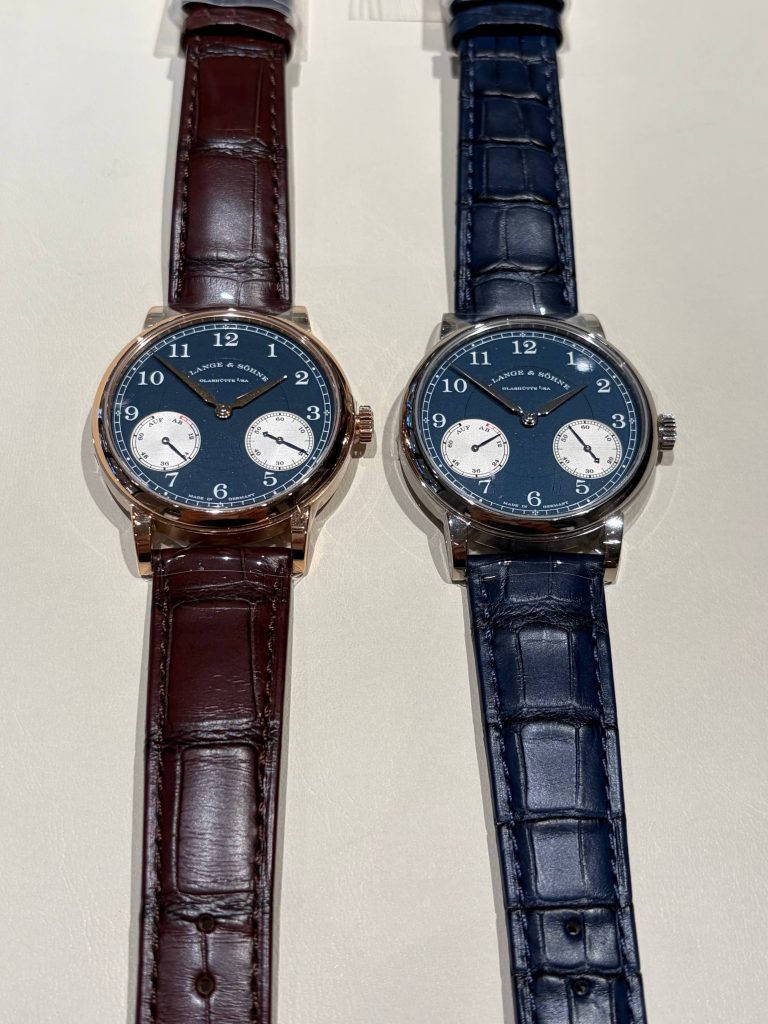
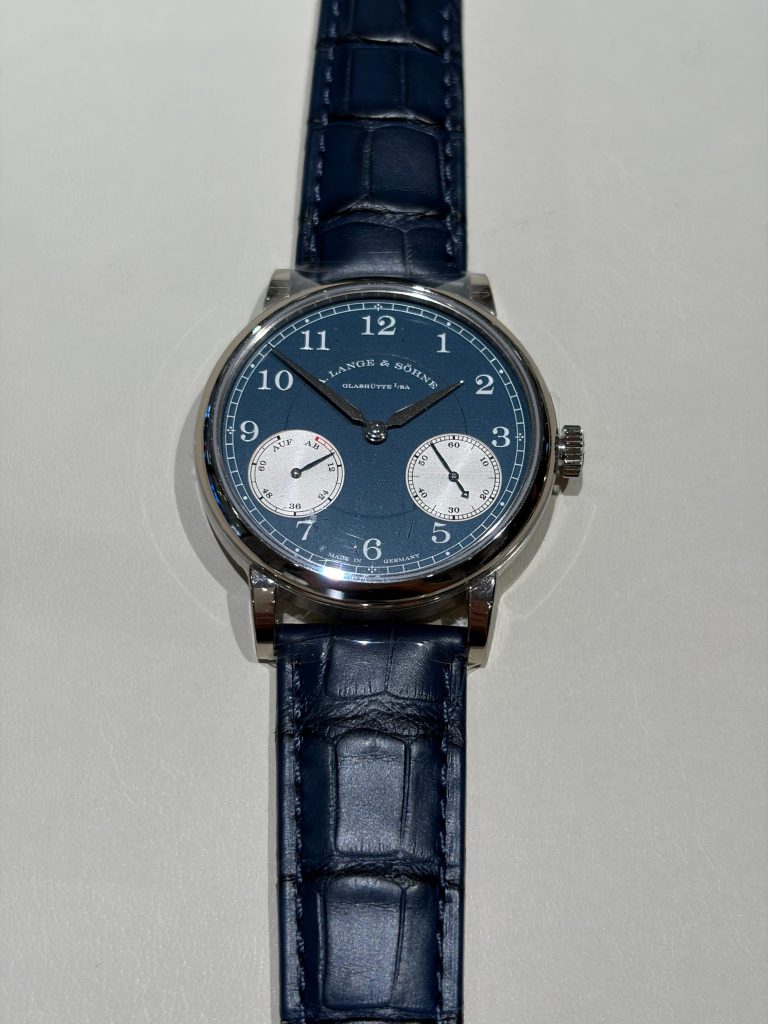
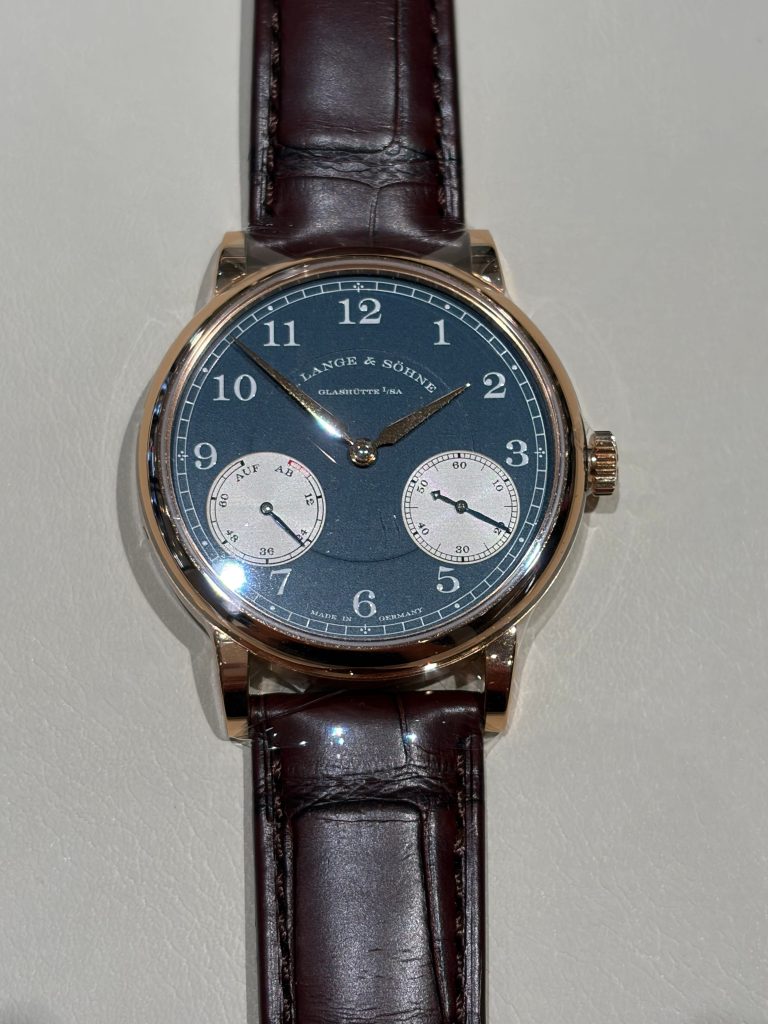
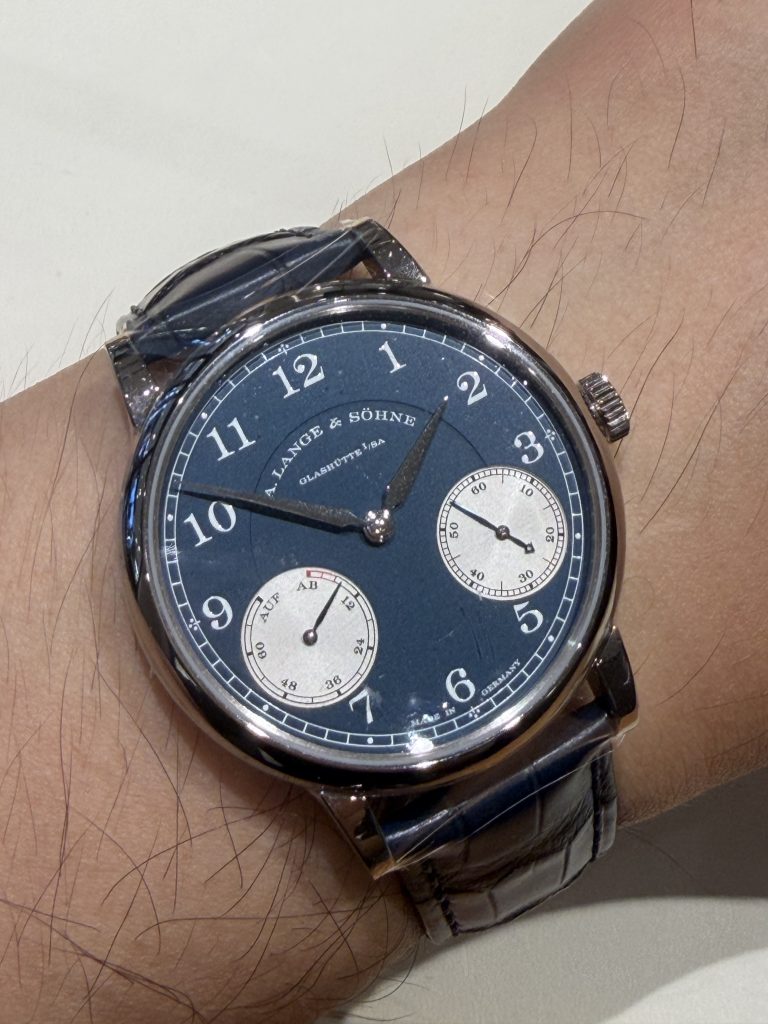
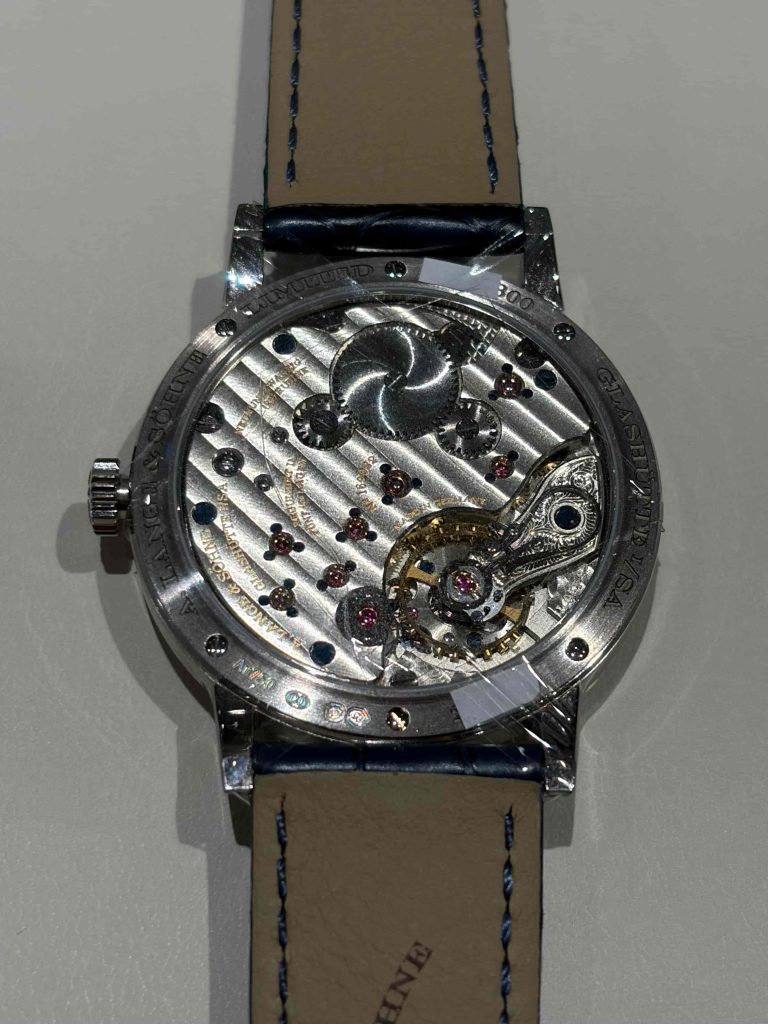
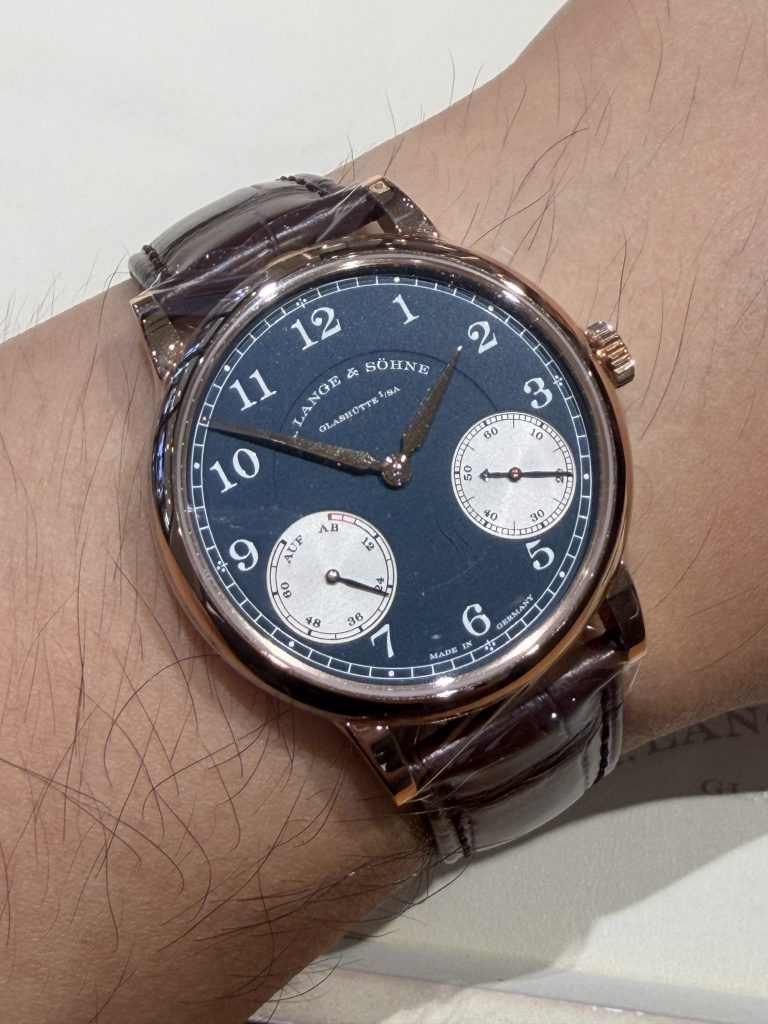
The 1815 Up Down has long been a classic model in the 1815 line up. While the time only version offers the most classic dress-watch looks, the Up Down adds more details to the dial by having a power reserve sub-dial, which is positioned perfectly opposite to the seconds sub-dial.
Released in white gold and rose gold, the new 37.5mm 1815 Up Down has a size smaller than the 39mm standard production 1815 Up Down. The dial, made of solid silver, is very eye-catching as it features contrasting sub-dials, or a reverse panda dial. The blue dial is something to behold. The two sub-dials stand out at a distance. The smaller case size does not make the watch look too small. Rather, it is the better size for such a dressy piece and it is more in tune with today’s watch trends, where smaller watches are preferred.
I myself much prefer the white gold version to the rose gold version. While the rose gold case may create sharp and striking visual effects with the blue dial, the more understated white gold version gives a more vintage vibe, which I prefer on the 1815. The hand-wound movement is as stunning as usual, featuring 3/4 German silver plate, engraved balance cock, and rubies in gold chatons. Each metal is limited to 300 pieces only. They should be sold out very soon.
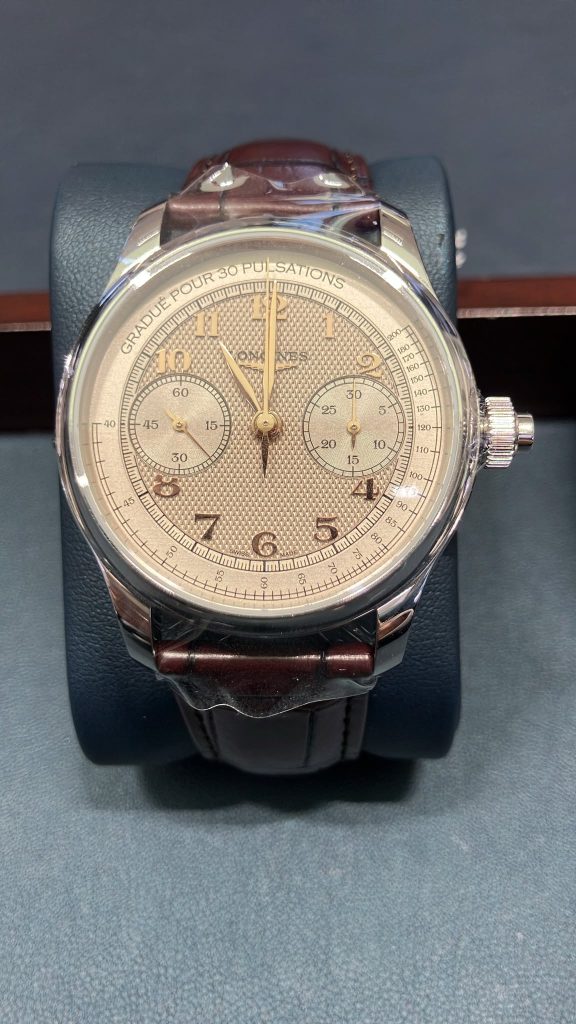
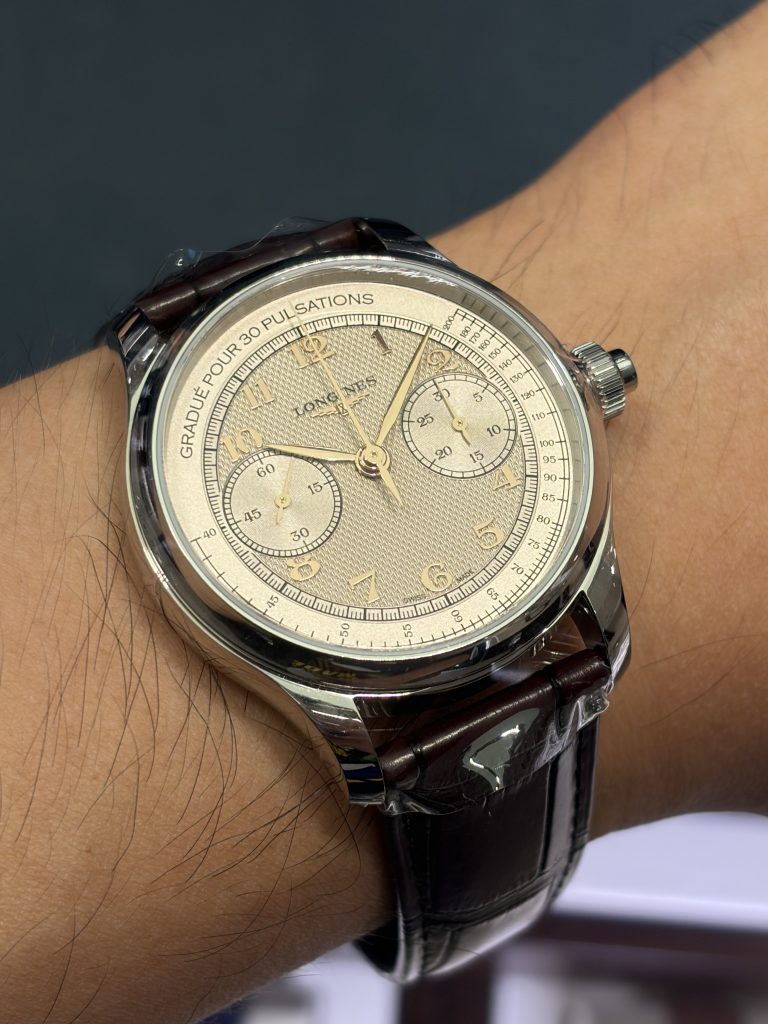
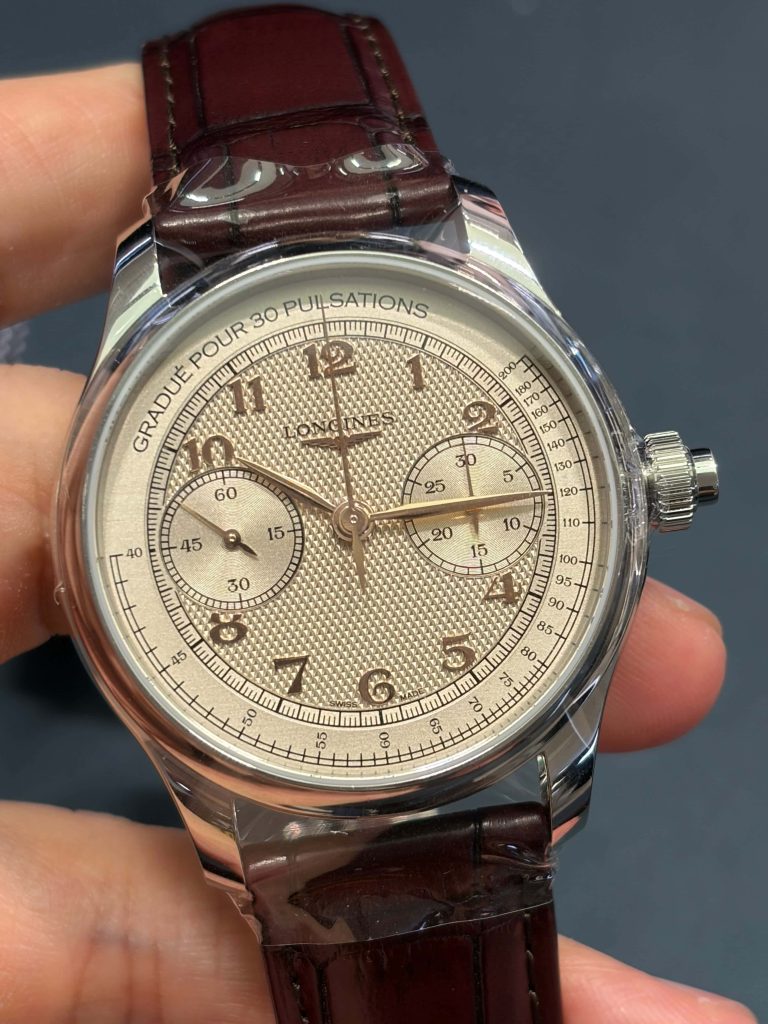
Longines has just released, to me, one of their best watches in recent years – the Master Collection Chrono Monopusher.
The stainless steel 41mm case is well polished and displays elegant curves. At 12.6mm thick, the watch sits comfortably on the wrist. Although 38-39mm would have been a better case size for a dress watch like this, the slightly larger and thicker case gives it more wrist presence on thicker wrists, making it look a bit more sporty as a chronograph. And of course, what steals the show is the finely executed monopusher at 3 o’clock which, unlike traditional three-pusher chronographs, starts, stops and resets the chronograph.
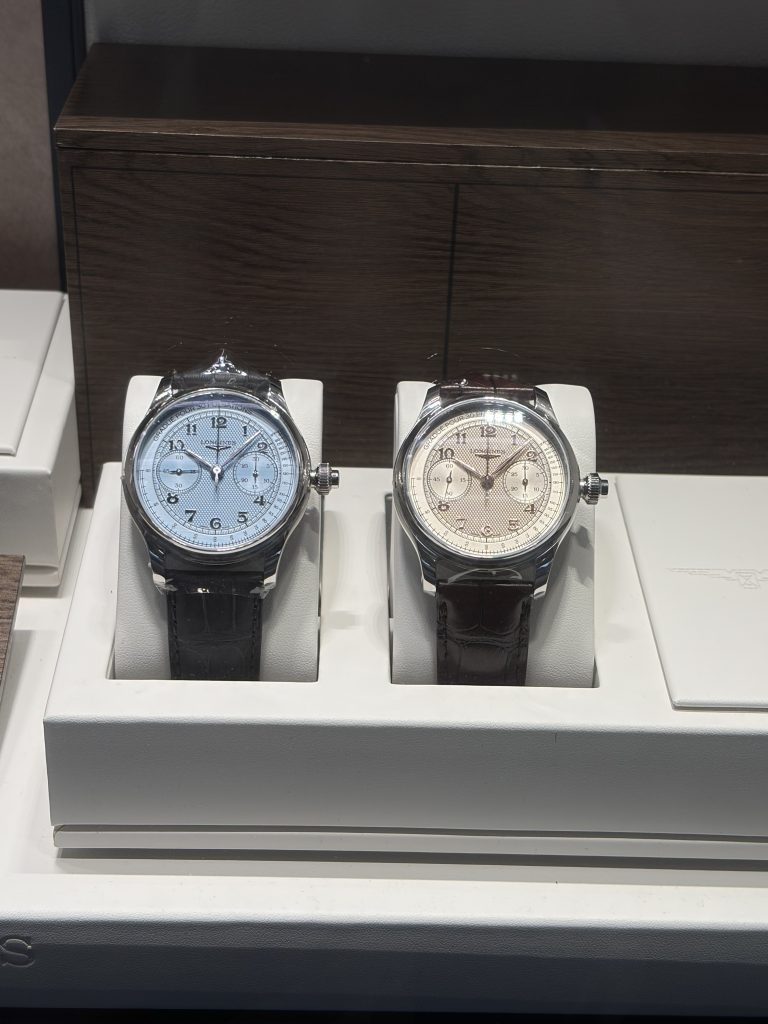
The dial is what I like the most about this piece. The watch is released in two dial variations. One is the ice blue dial which has a cold mysterious tone and the other one is the warm silver opaline dial which I prefer. The best thing about the opaline dial is its rose gold applied numerals, which can look silver depending on the lighting, complementing perfectly the barleycorn guilloché dial. The vintage vibe of this dial variation wins my heart. The leaf-shaped hands, paired with the pulsation scale around the dial, create the perfect recipe for a vintage-inspired monopusher chronograph dial.
Through the display caseback, the hand-wound Longines L799.5 column wheel movement can be admired. It is well decorated with Geneve stripes,blued screws and blued column wheels, offering a power reserve of 68 hours.
I do think this is a watch done right in almost every aspect. At 27,700hkd, you get a monopusher chronograph, which is by all means a high-end complication, a guillochéd dial and a displayed back that shows you a hand-wound movement. The watch reminds me of Patek’s monopusher chronographs which sell for a much much higher price. This piece is absolutely bang-for-the-buck.
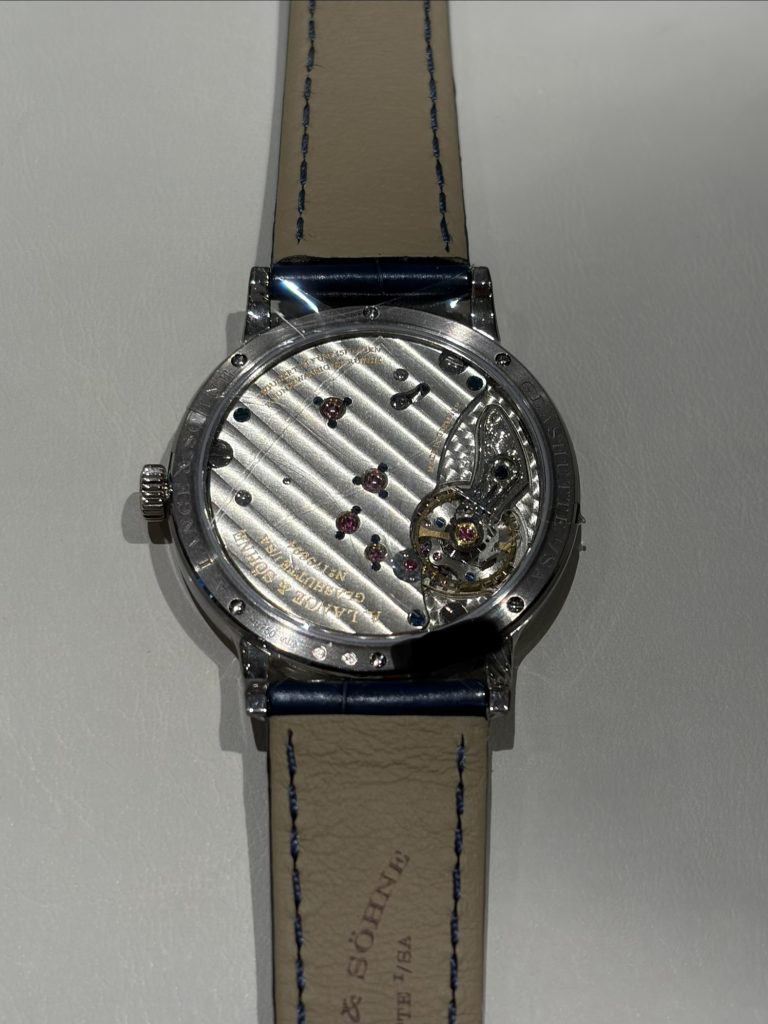
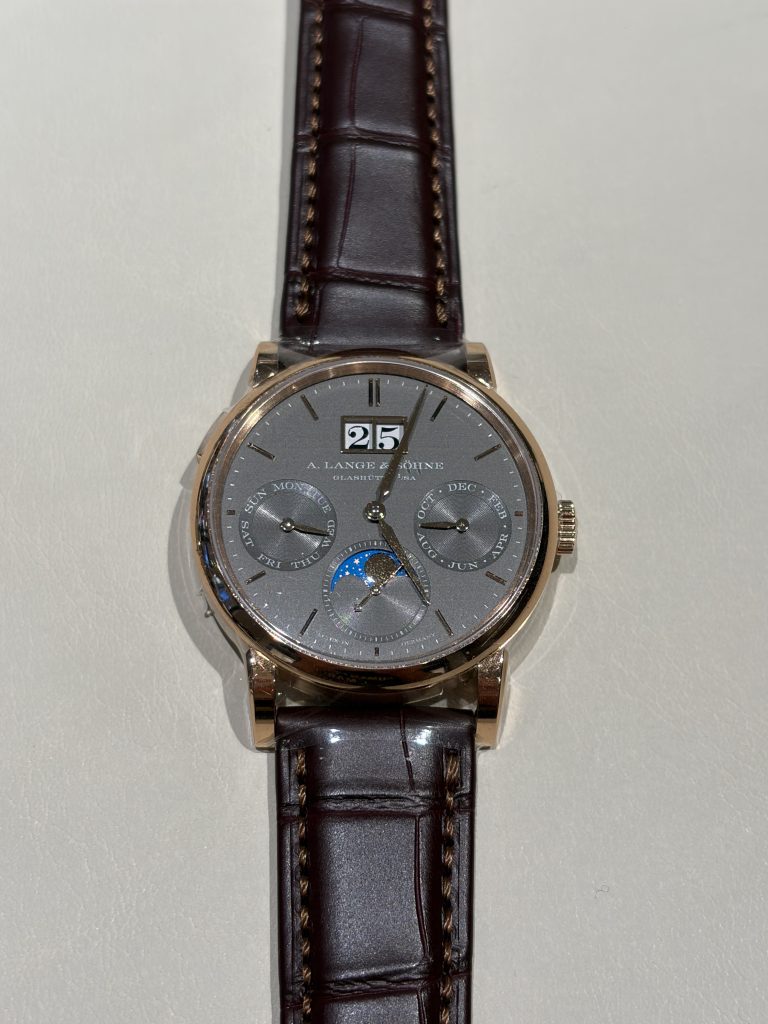
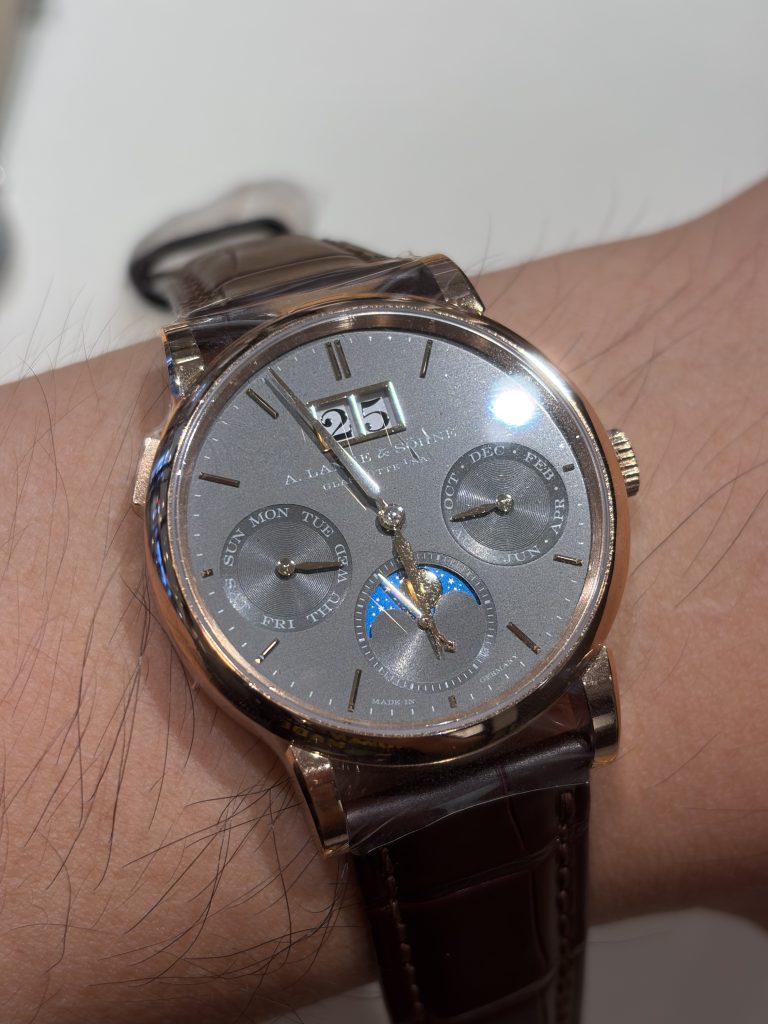
Yesterday, I was fortunately invited to check out the novelty from A.Lange which will be released soon in early September. The new model is superb and I do believe everyone is going to love it. However, it has to be kept confidential so I cannot disclose any details here. While I was there, I was shown another two marvelous pieces which were the 1815 34mm and the Saxonia annual calendar.
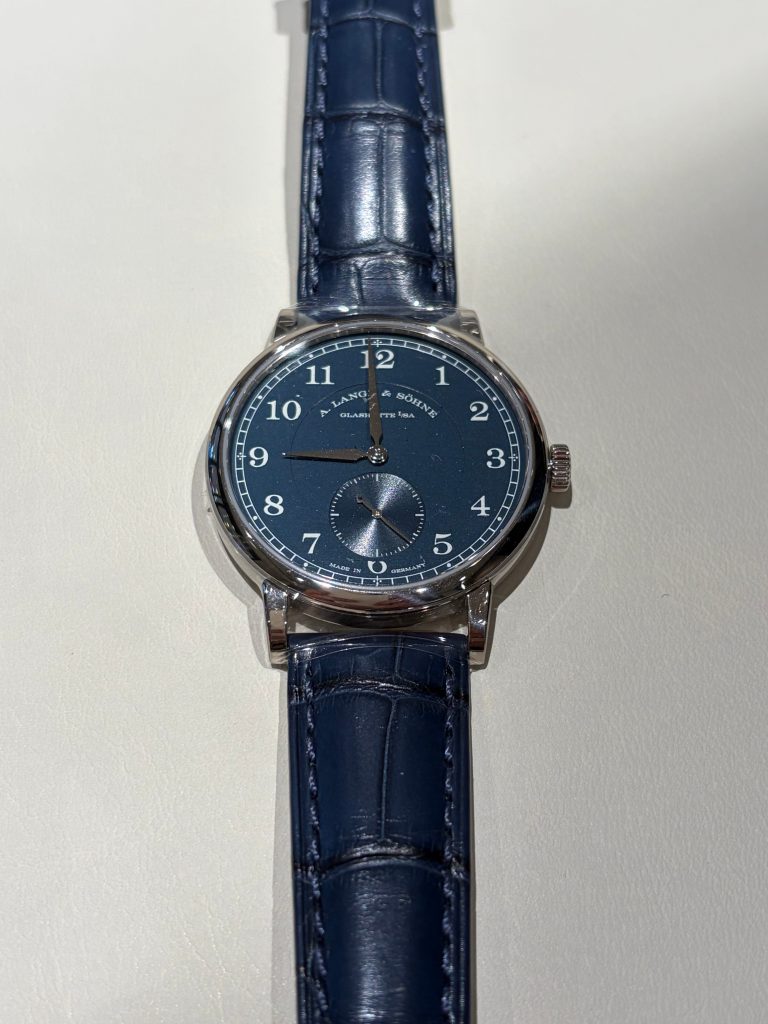
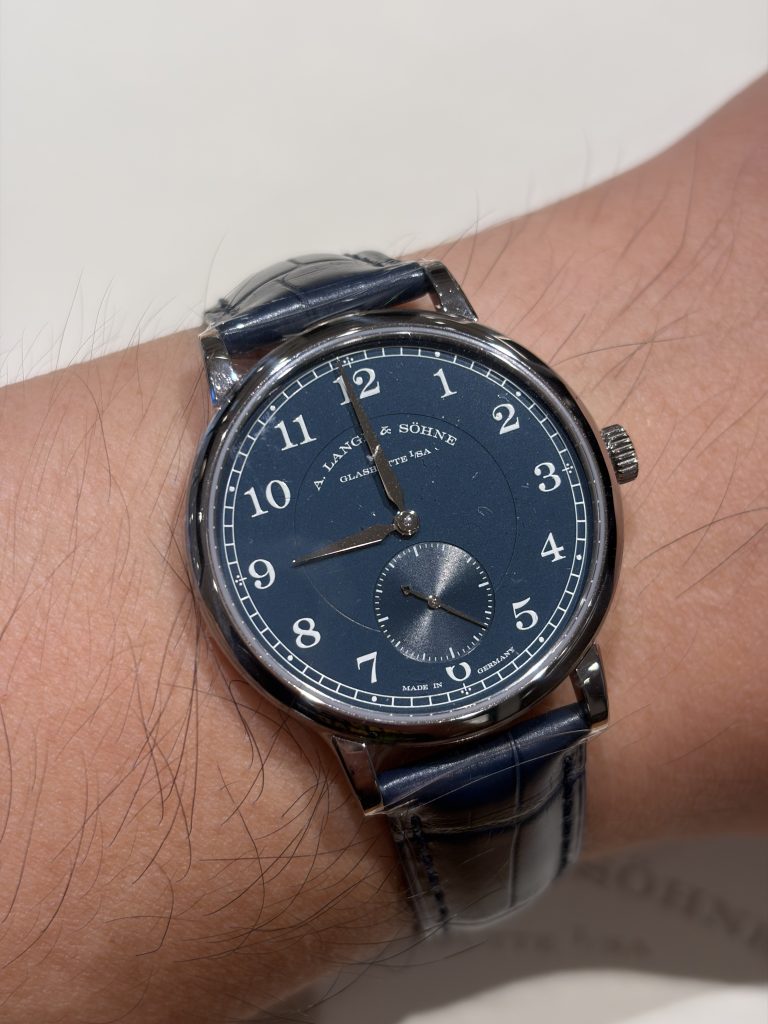
A.Lange does not release watches in blue dial very often. When they do, these watches are oftentimes limited or special editions. The Datograph 25th anniversary in white gold and blue dial, released in 2024, is one of the examples. Yesterday, I had the opportunity to try on their 1815 34mm model in blue dial released in 2025. The watch feels both vintage and modern. At 34mm, the size itself carries a strong vintage vibe. The finishing of the blue dial, hands, the case and the movement is as incredible as you would expect from Lange. The finishing of the movement is especially dazzling when you behold the many rubies embedded in gold chatons which are secured by blued screws. At first glance, the watch could be too small for men. However, after trying it on, I think it fits perfectly into today’s trend of small watches which celebrates the pre-war size of mens watches rather than chunky 44mm beasts. The tone of the blue dial, complemented well by the white arabic numerals and the small seconds sub dial at 6 o’ clock, is simply just right for this piece. Overall speaking, it is a timeless design done right with modern finishing.
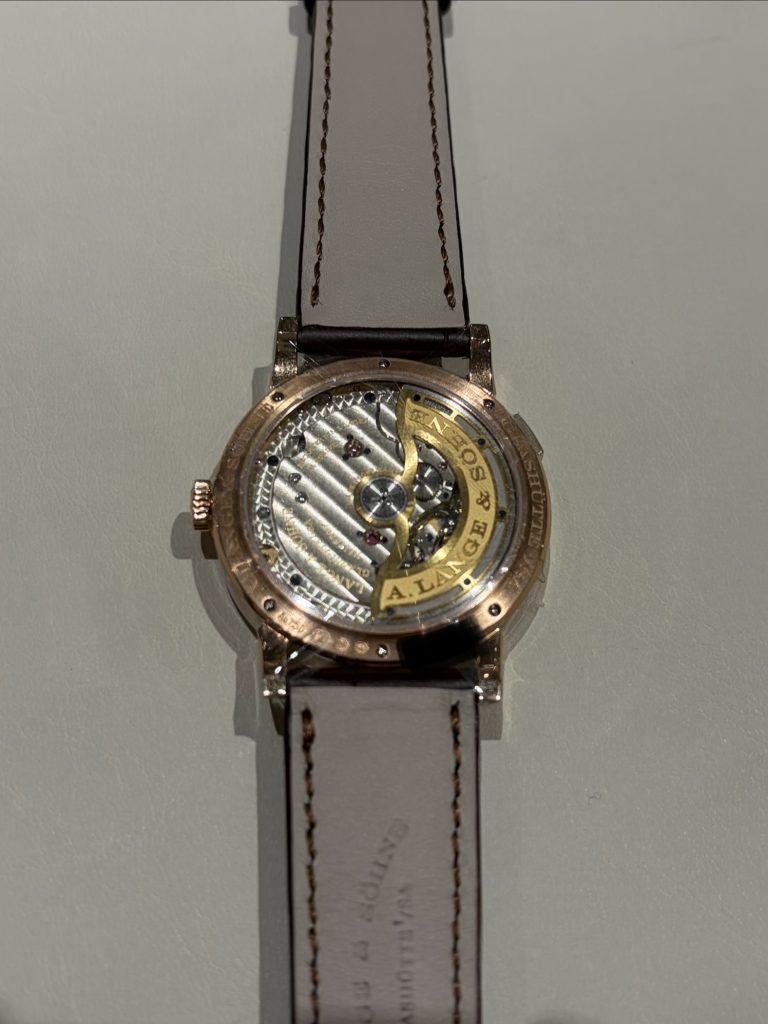
Another watch I took a look at was the Saxonia annual calendar in rose gold and grey dial released this year in 36mm. While I do not have a particular liking for the Saxonia collection, this piece is absolutely eye-catching due to its color combinations of rose gold and grey dial. Downsized to 36mm from 38.5mm, the watch looks more compact and elegant while being less chunky. The dial layout is very legible and it is a pleasure to look at the beautifully finished grey dial. However, the fact that the rotor is only gold-plated is something that I find a bit off for a high-end timepiece like this.
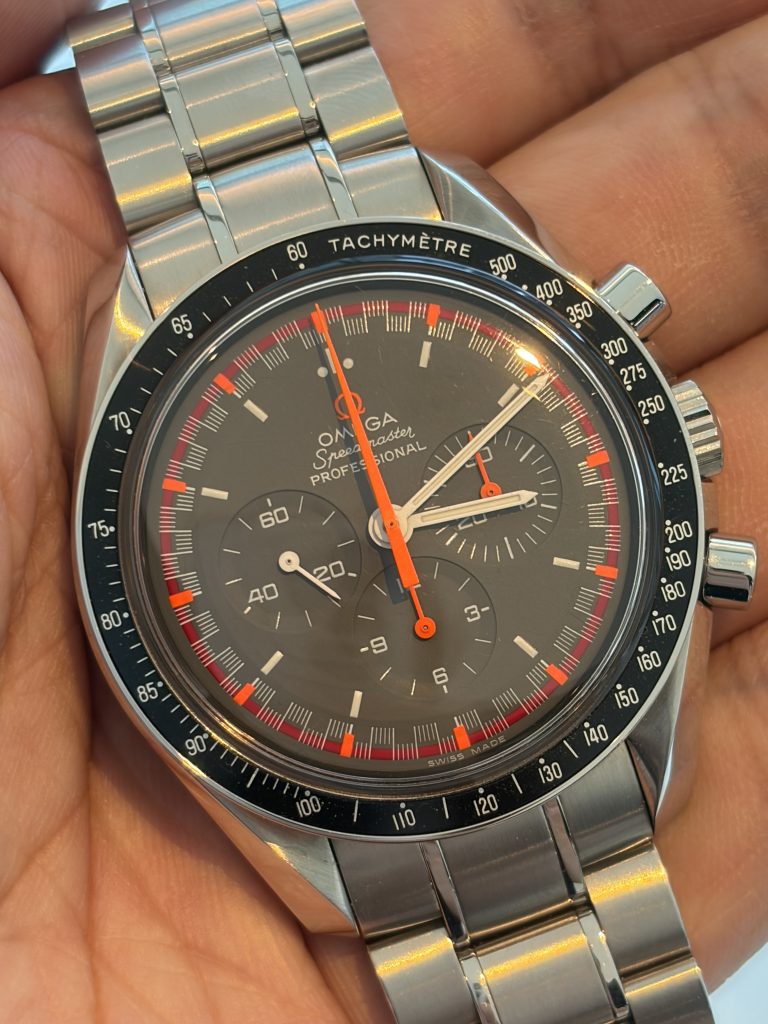
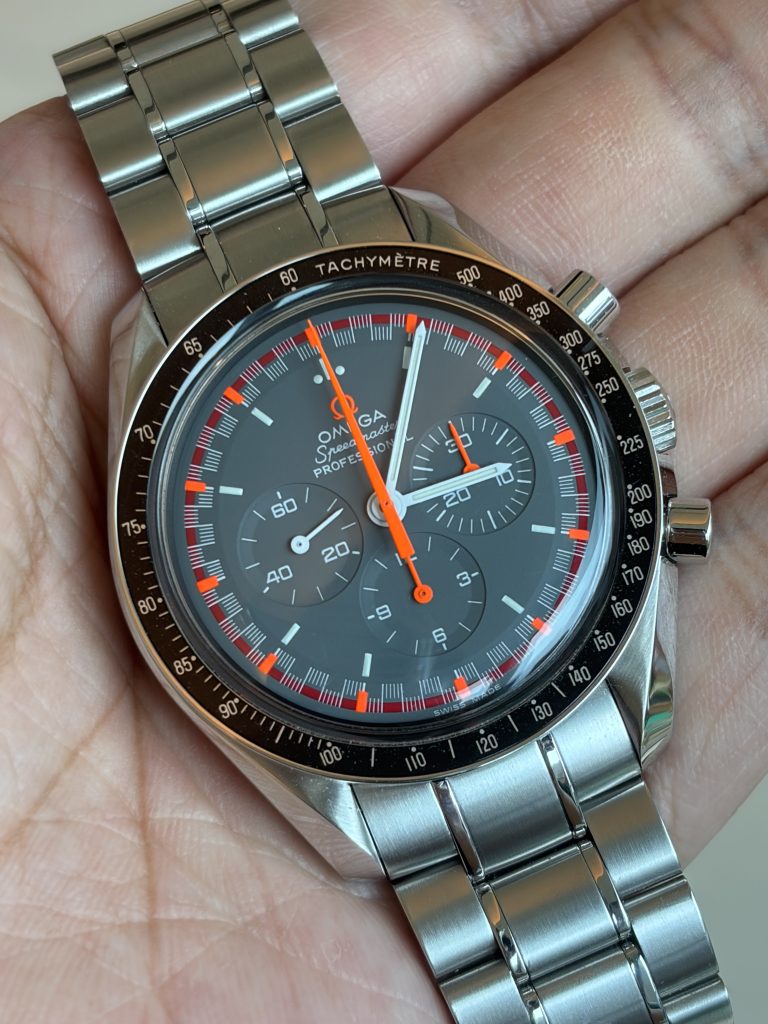
While the Speedmaster sports a lot of different dial variations, the racing dial is definitely one of the most mesmerizing, exotic, and sought-after dial variants. The panda dial may have won some hearts, and while some may have a special liking for the Apollo moon landing dials, the racing dial Speedy from the 1960s remains one of the grail Speedmasters in today’s market.
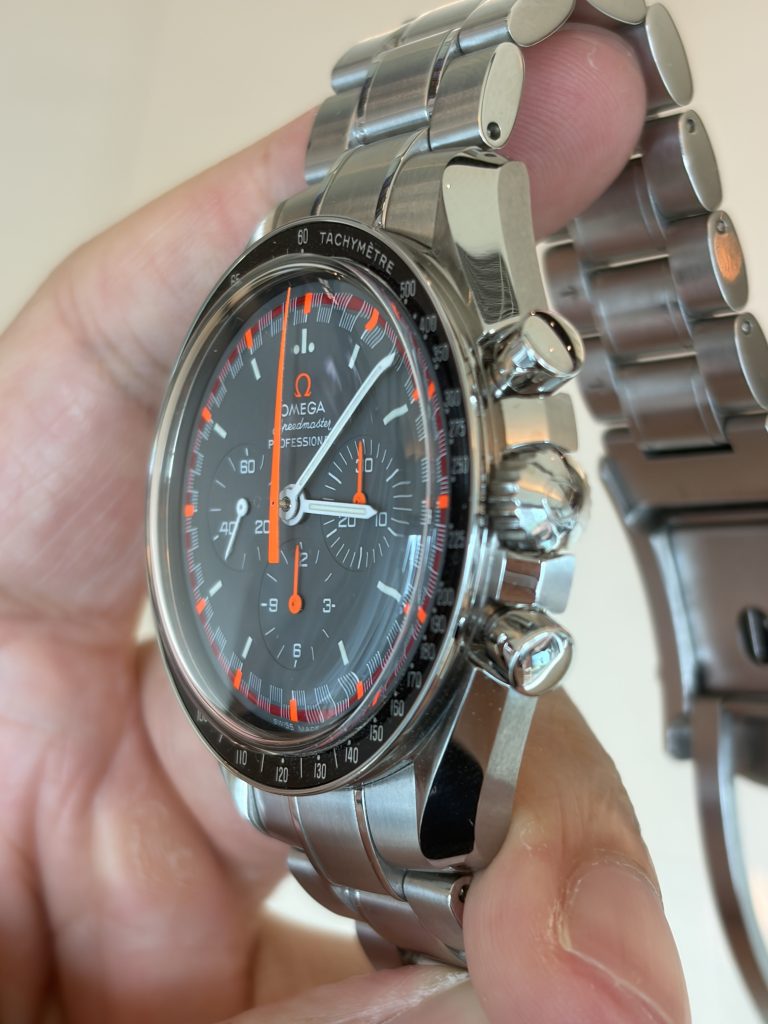
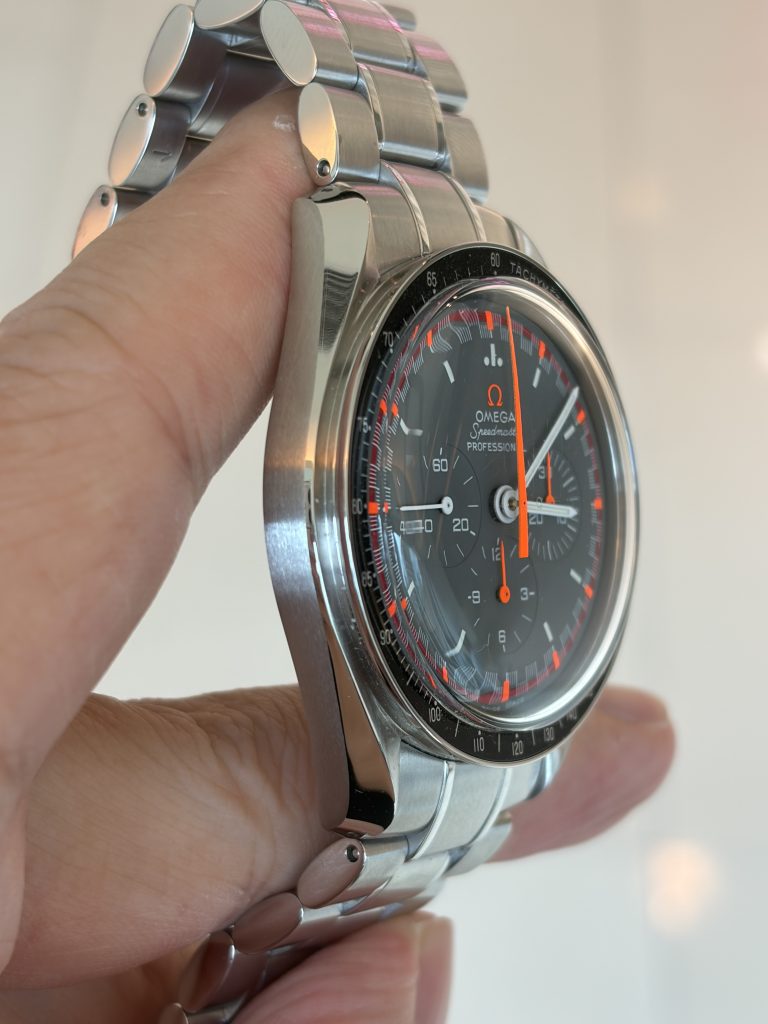
This 3570.40, or Japan Racing Dial Edition, is one of the more budget friendly racing dial Speedmasters. At 42mm, limited to 2004 pieces, this model is not as expensive as its grandfather from the 60s while offering faithful aesthetics in a more modern interpretation. Powered by the 1861 movement, the 3570.40 is a chronograph that, apart from the Speedmaster’s root in space, comes back on Earth and returns to the root of chronographs – racing. The correct serials should fall between the range of 77,128,xxx to 77,134,xxx.
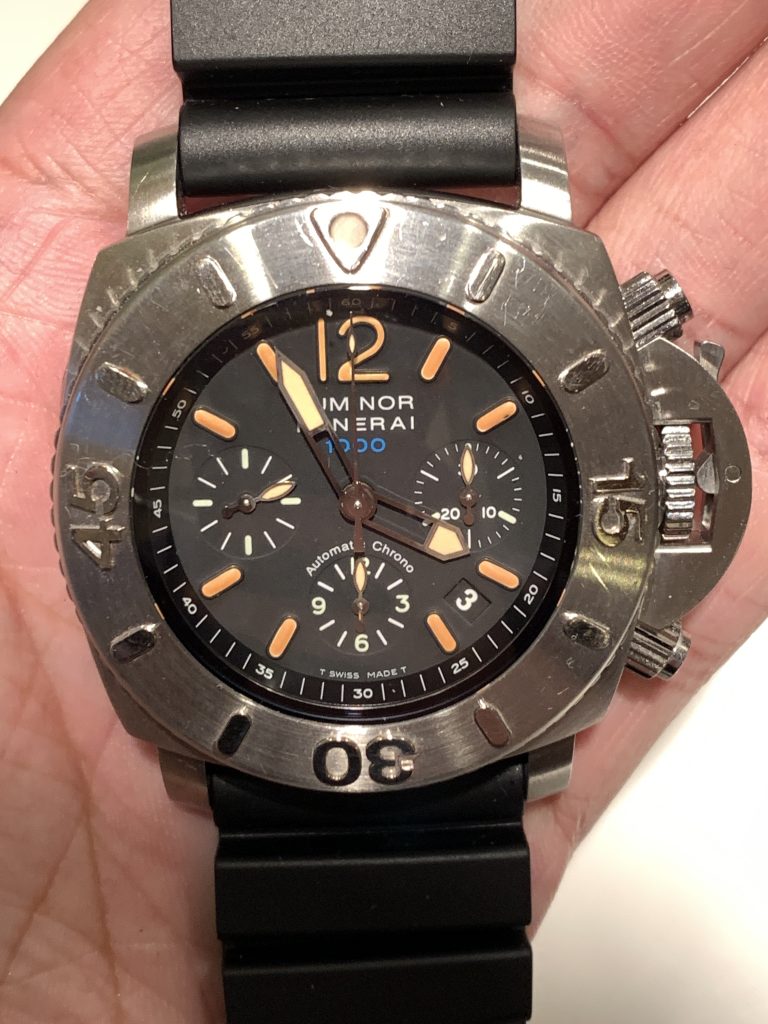
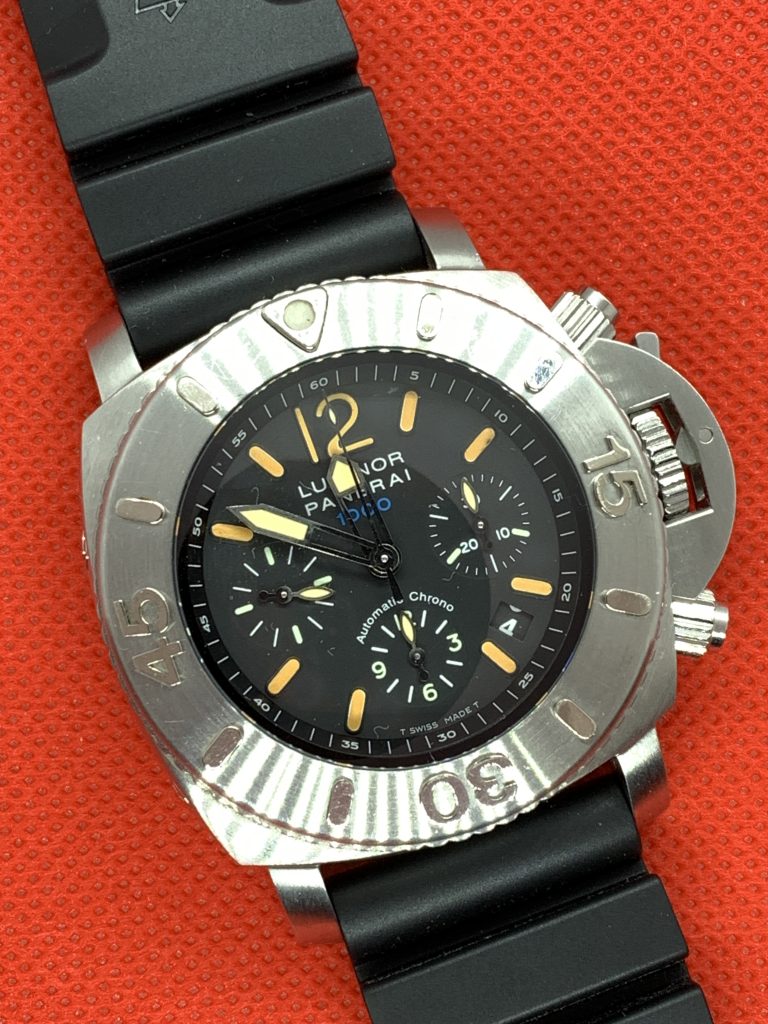
The good old days of Panerai may be long gone. I still remember how pricey those limited Submersibles used to be back in the late 2000s to the early 2010s. Back in the the days when I purchased my first mechanical watch which was a Pam312, those Submersibles were untouchable for me as they could easily fetch for 150k hkd, three times the price of my brand new 312. The Pam187 was one of them.
Is it a good time to buy collectible Panerai watches? Will the brand regain its lost glory? It is anybody’s guess. However, these special Submersibles, be they 44mm or 47mm, limited or not, are still collectible to me. The rugged and bold Italian design language is not very commonly found on any other brands’ dive watches. Among the many Submersibles, the 47mm 2500m or 1000m models are the best to me.
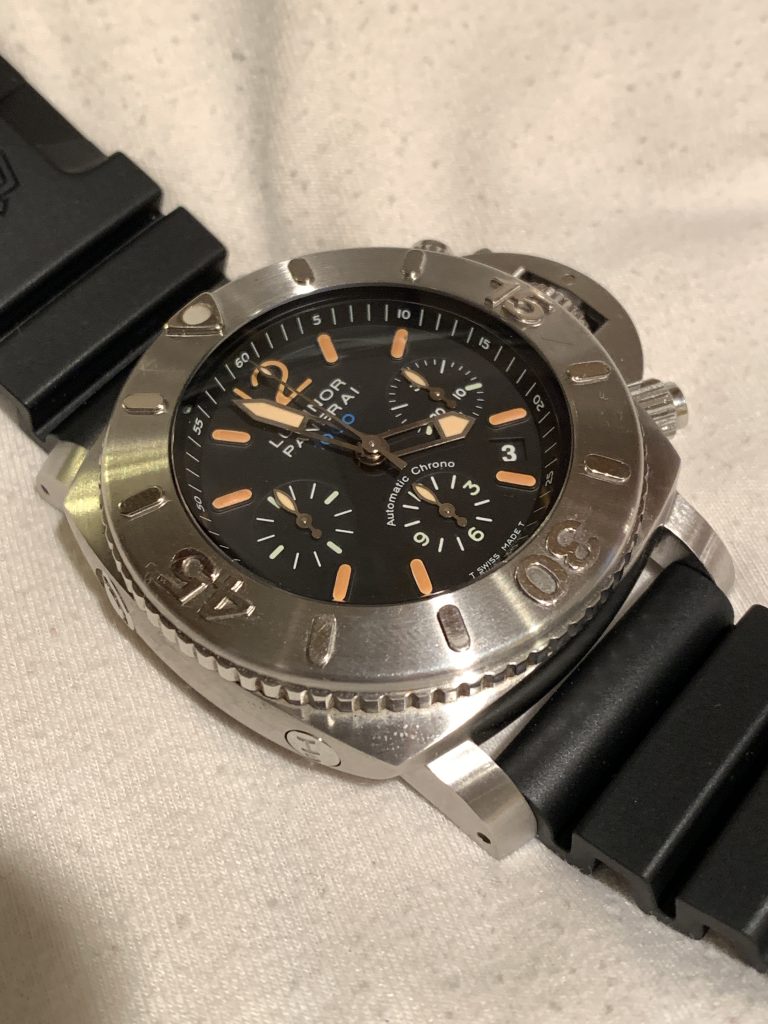
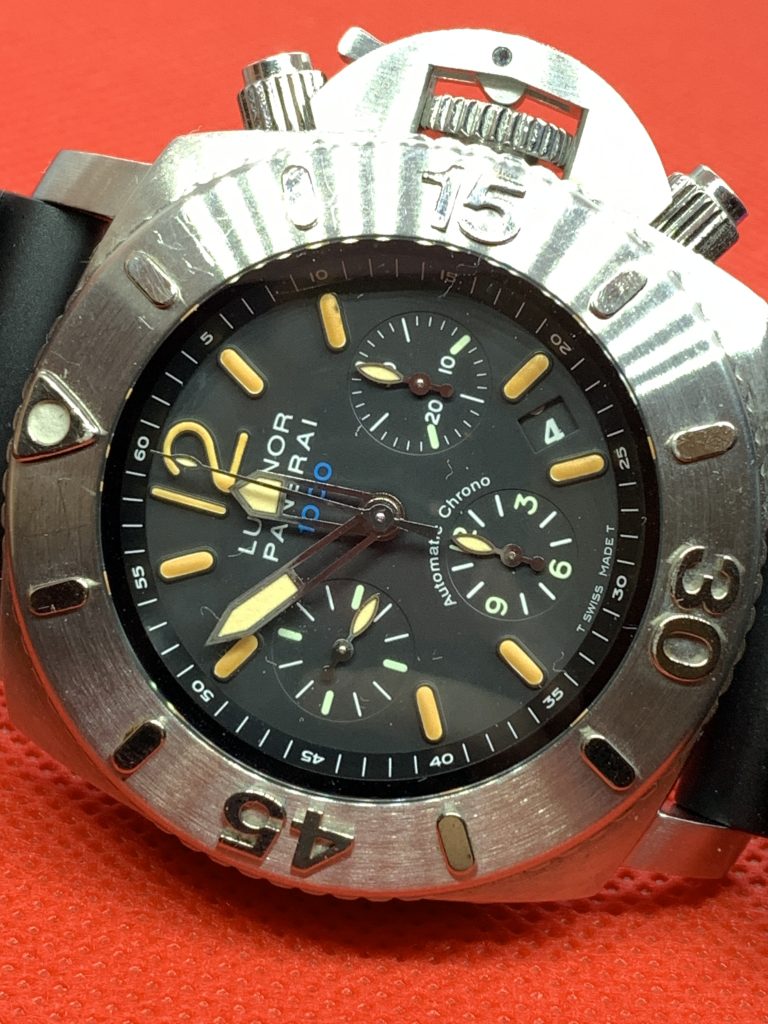
The Pam187, released in 2004 as a 1000pcs limited edition, is a 47mm stainless steel beast. While the Pam194, a titanium 2500m limited edition, is equally collectible to me, the heft of the 187 makes it more special in some ways. What makes the watch more appealing is that it is a bold chronograph with screwed pushers which gives it an even more rugged look. The blue 1000 printing on the dial adds some good contrasting color to the black dial as well. A rather special feature of the 187 is that it features a screwed pusher on the case at 10’o clock for date adjustment. Any date change has to be adjusted using a special tool to unscrew the pusher first. There is also a helium escape valve on the case at 8′ o clock.
In any of these 2000s limited Submersibles, the dial plays a big part in the overall aesthetics of the watch as the tritium markers should have already turned quite yellow or orange. A pumpkin color dial is much more vivid on these Submersibles than the light yellow ones. However, one has to check the dial carefully to see if there is any water marks of black spots on the markers as these tool watches may have been heavily used underwater. For a Pam187, one has to always check if the date adjustment pusher and the chronograph function are in good working condition. Also, if possible, look for an unpolished case even if it looks a bit heavily used.
Now may not be the days when big watches are in vogue. Nevertheless, these tritium Panerai Submersibles are definitely worth collecting at their current prices if you are into big bold tough-guy dive watches.
Watch collecting, in some ways, require some sort of philosophies for one to go the right way. One of the ways to acquire such philosophies is to talk with seasoned collectors who have been in this hobby for a long time. I was lucky enough to meet with Mark Chan, a seasoned and sophisticated collector, in his watch shop Jellybean Watches in Wanchai.
“Be true to yourself.”
It is one of the most important codes to observe when it comes to watch collecting. Trends can change easily and one could be influenced easily nowadays by social media as to what to collect next. One of the best ways to establish a solid collection is to know your watches in depth by digging into their history and stories. Watch collecting should not be a competition. It should be fun and knowledge-based. There are books to be read and homework to be done before making a purchase. It is so much about what you have learnt that when the opportunity is served, you can make the right buying or selling decision. Sharing and exchanging with others could be one of the best ways to get to know more and more of the watch world.
Patek Philippe Nautilus 3800 in platinum with diamond dialThe heft of platinum and the shine of diamonds
The Patek 3800 Nautilus is one of the pieces shown today at his shop. At one point Mark had all the 3800s in six metals in a 3800 exclusive display box which is, again, ultra rare. This 3800/1p is a mesmerizing piece in the sense that the platinum case has such a heft that complements so greatly with its soft ,but sharp, gradient blue dial. It is certainly not any Nautilus you will see casually anywhere. At 37mm, it is sized for any wrist and this size will only get more popular in the coming couple years as smaller watches are gaining momentum.
An ultra rare box for Rolex King MidasKing Midas in white goldKing Midas in yellow gold
You may have seen a Rolex King Midas. But I bet you may not have seen two of different metals at the same time. Here they are: the King Midas in white gold and yellow gold. Maybe you have seen two of them together but I bet not many have seen the box for King Midas. It is not the watches only, sometimes, that are fun to collect. The accessories are part of the game as well. The King Midas is definitely one of the hottest watches on the market now as watches with unique design and integrated bracelets are coming back thanks partly to the release of the new Piaget Polo. Interestingly, the white gold King Midas weighs more than a platinum PP3800. Solid Rolex in the old days!
Cartier Normale skeleton
Cartier is an interesting brand that blends jewelry with watchmaking perfectly. You can probably think of no other brands that can produce so many significant watches in different shapes. The Tank, Santos, Americaine, Cloche, Normale, you name it. This Normale in white gold features a 24 hour skeleton dial that blends the sun and the moon at 12 and 6’o clock perfectly with the gears. You just can’t beat Cartier when it comes to genius design and aesthetics.
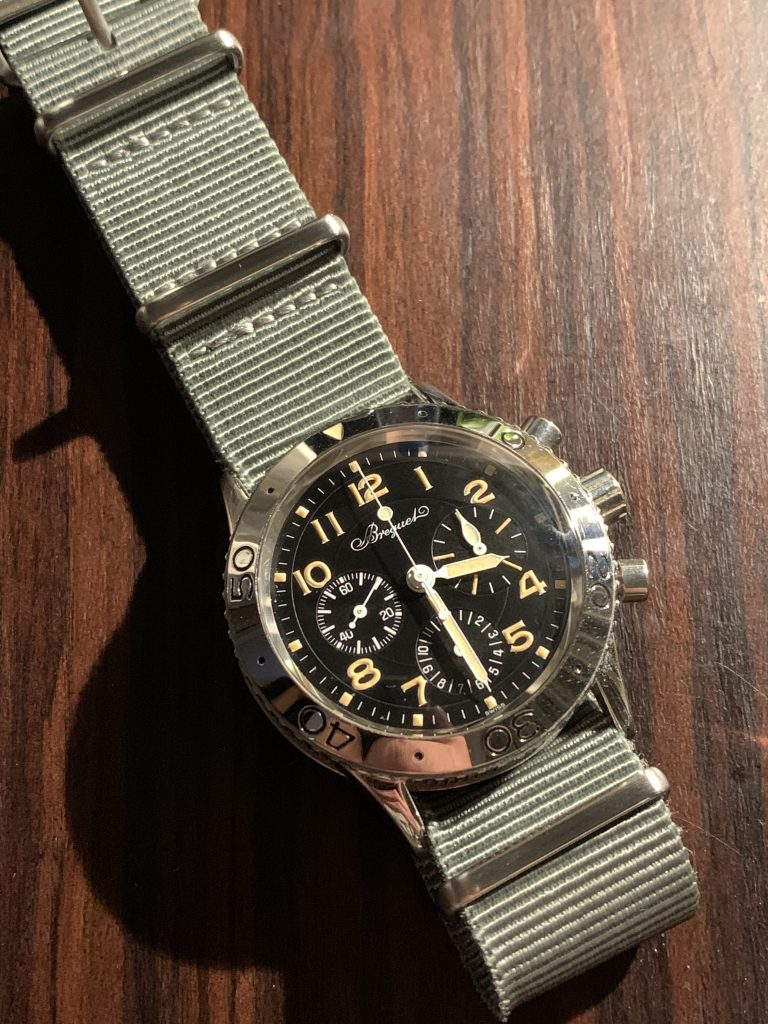
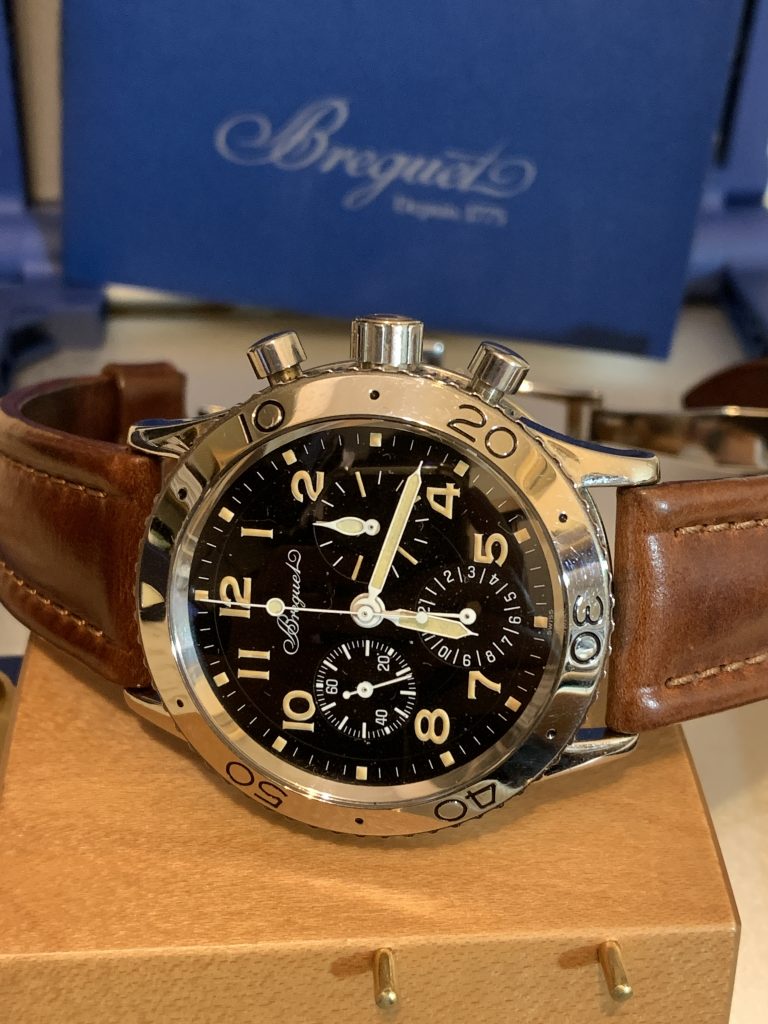
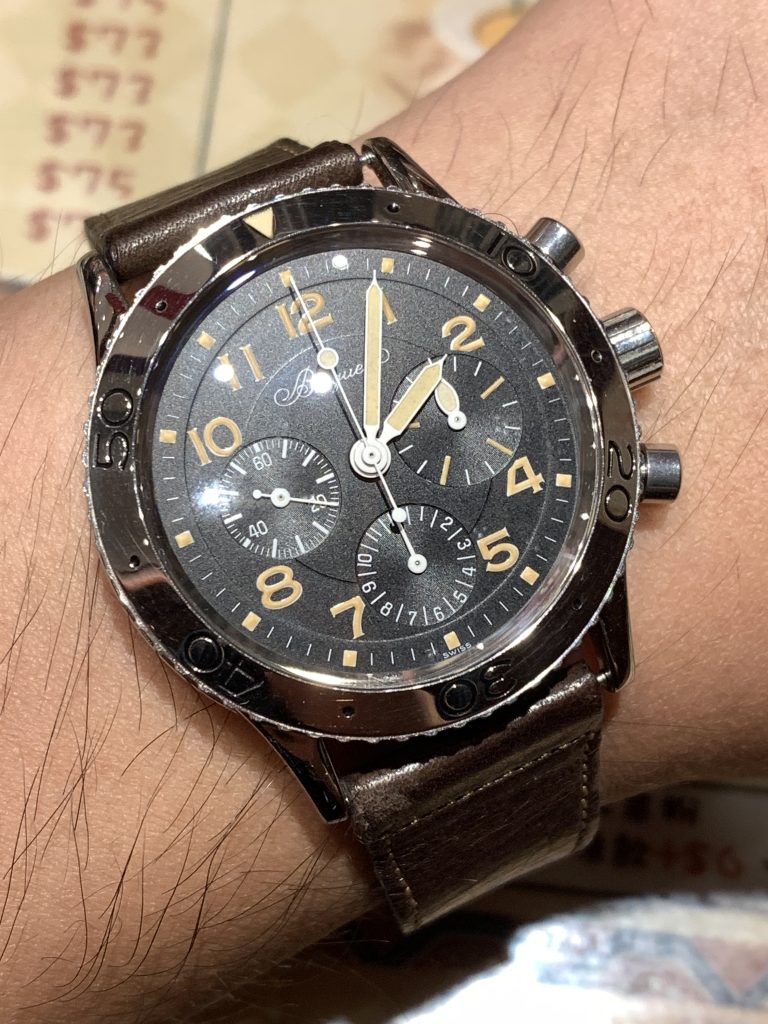
When it comes to pilot watches, Breguet has always been a big name among collectors. The Type XX, the brand’s signature pilot watch collection, has just received an update not long ago. While the new watches pay homage to their vintage ancestors, the Type XX 3803 stands out as an anniversary limited version.
Designed for the French Naval Airforce in the 1950s, the Type XX has its historic significance in military pilot watches. The pedigree of the line can hardly be matched by any other pilot watch collection. The ref 3803 was released in 2010 to mark the 100th anniversary of the French Aeronavale and it was made as a limited edition o 1000 pieces.
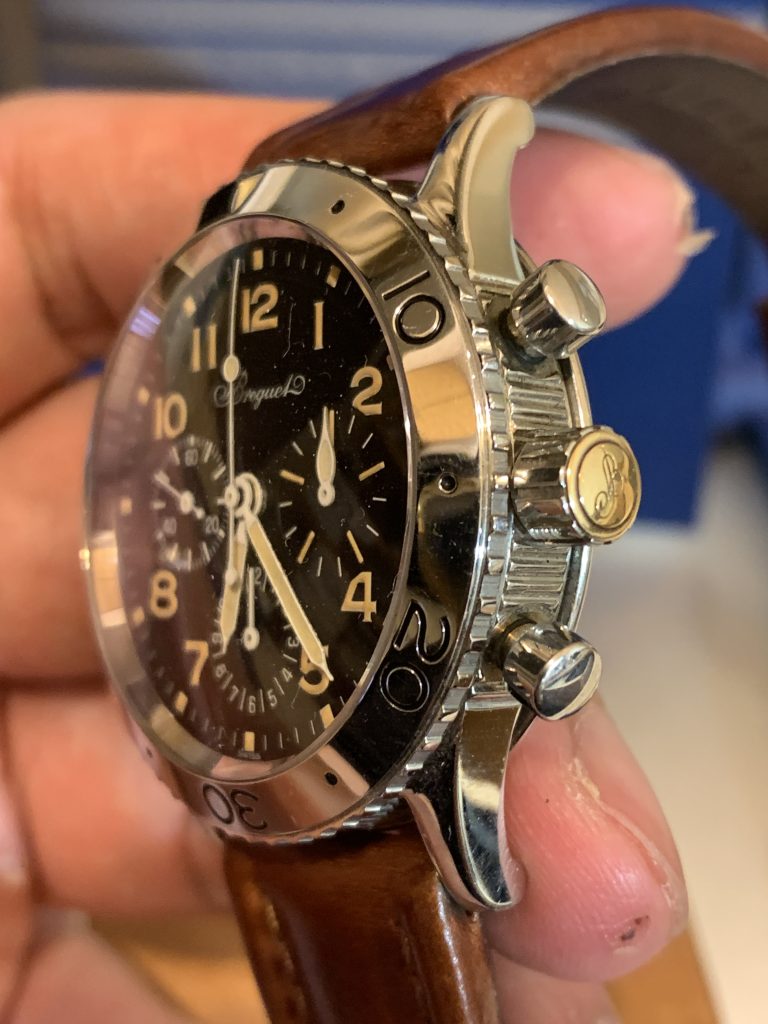
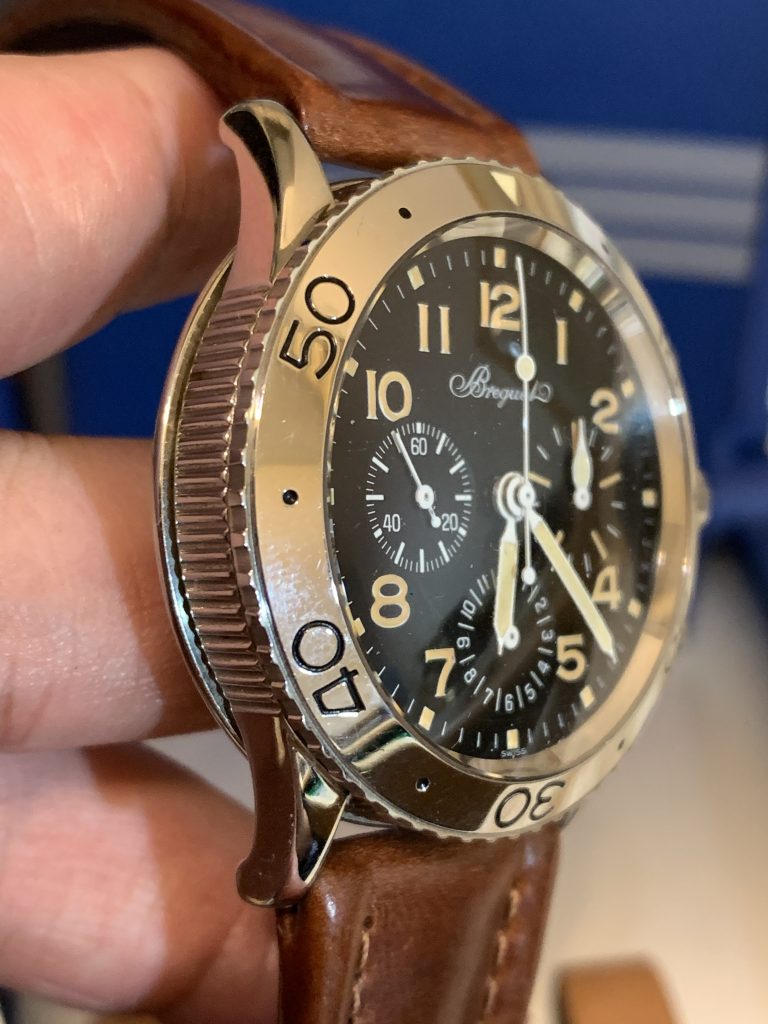
Sized at 39mm, it is a perfect watch for wrists of any sizes. As a military pilot watch, you may find it more elegant than subtle. That is also why Breguet pilot watches are special as the craftsmanship is unlikely to be found from other manufactures. The 3803 has a highly polished steel case featuring Breguet’s signature coined edge. What makes this ref stands out is actually its bezel which is in black lacquer with raised numerals. The craftsmanship on the bezel that has so many details is unmatched. The watch itself, from a distance, is quite recognizable as it is the only ref in Breguet’s pilot watches to have such a bezel. The shine of the whole piece is greatly enhanced when you compare it to the polished bezel of the 3800. The dial itself features luminova Arabic numerals which are very easy to read and the layout it very neat as well. The omission of the date function makes the dial more balanced than those with a date window. What makes the watch even more retro is the use of the onion crown which is not commonly seen in modern pieces.
Function wise, as always, it is a flyback chronograph. A flyback chrono allows you to time another event without resetting. The movement is a Breguet 581 automatic chrono movement. The watch comes with a padded calf strap in black and a deployant buckle.
Overall, the 3803 is a modern classic that will stand the test of time. The size, dial, case and its meticulously made bezel are some of the best you can find in a pilot watch. While hunting for a pilot military watch at the price range of 60-70k HKD, the 3803 is not a bad choice at all.
Omega is pretty much a synonym to the Speedmaster, the moon watch, especially after the Moonswatch hype. While there are many Speedmaster models available out there in different sizes and materials, a good 145.022 with tritium lume is still hard to beat as a classic 42mm Speedy.
The 145.022 was introduced in 1968 to replace the 145.012 and it remained to be in production until around 1981. Powered by the classic 861 manually wound movement, the watch features a 42mm case and a tritium dial with three sub dials displaying the seconds, minutes counter and hours counter. It gives a very classic Speedy looks at a very reasonable price (30-40k HKD) Compared to more vintage Speedy like the Ed White or the Board Arrow, the 145.022 is much more affordable.
When one looks for a 145.022, he should carefully check whether there are blemishes on the dial as many of them were not very well waterpoof. Moist could get into watch and damage the dial especially the lume. It is important to have a clean dial as it affects the watch’s value a great deal. An unpolished case would also be very much appreciated.
When we talk about pilot watches, the Breguet Type XX 3800 is certainly on the list. The coin-edge caseband and the flyback chronograph make it one of the most recognizable watches out there. Originally made for the French Ministry of Defense in the 1950s, the civilian Type XX was produced in 1995.
At 39mm, the case size can suit most wrists. Unlike most pilot military watches, the 3800 is a more classy choice with its polished bezel and case. The case features a very beautiful coin-edge caseband which is a signature of Breguet watches.
The early version of the 3800 features a gold capped crown. This version was produced for one year only. The bezel, unlike later ones, is unidirectional. The ‘T’ on ‘Breguet’ is also different without the stroke. The flyback movement is a Breguet 582 which is based on the Lemania 1377.
This example here features a tritium dial with beautiful patina and it is available.
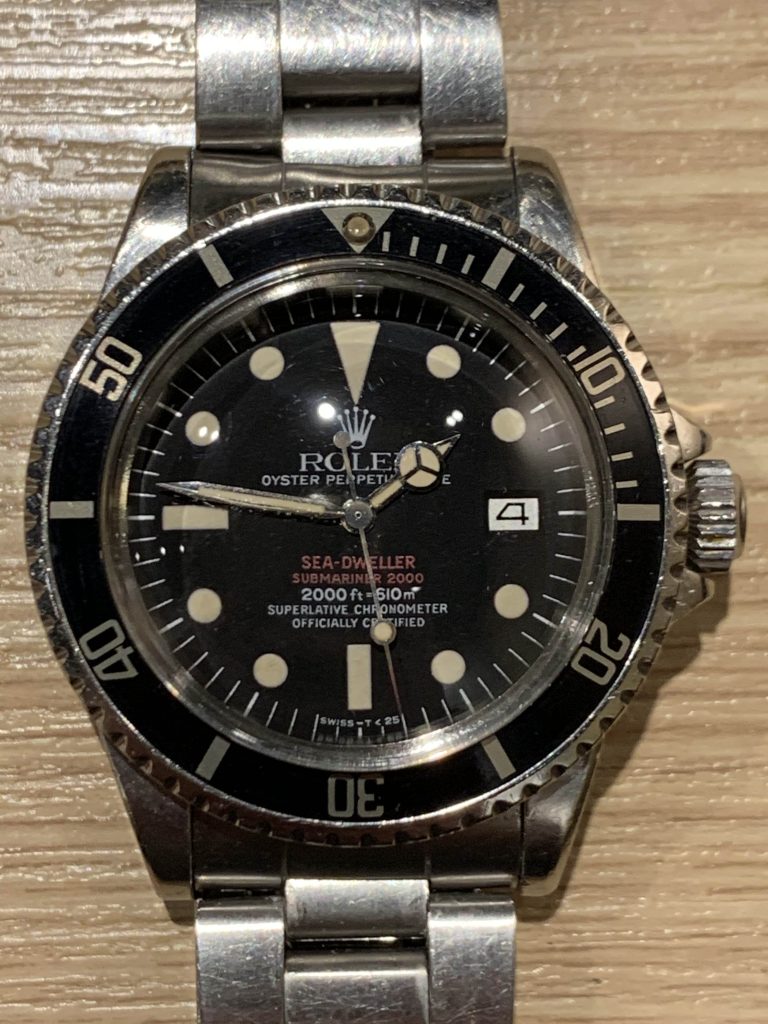
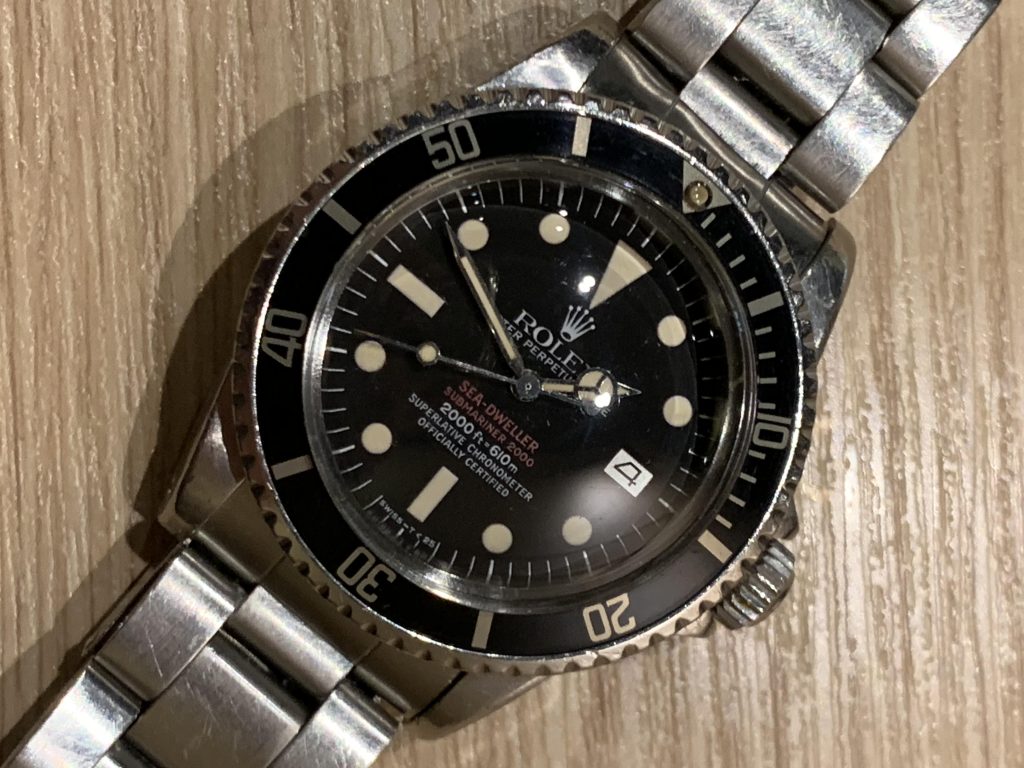
When it comes to vintage Rolex, the DRSD is absolutely one of the most talked-about model and could be many collectors’ grail watch. Being the first generation Sea-dweller, it is historically important. The features seen on this reference impact deeply the models to follow.
DRSD MK4 unpolished
While the MK1 and MK2 are rarer, more elusive and much more expensive, the MK3 and MK4 are easier to collect. The MK4 is slightly more popular than the MK3 given its sharper red color on the red fonts. There are a few things except period correctness that I look for in a DRSD.
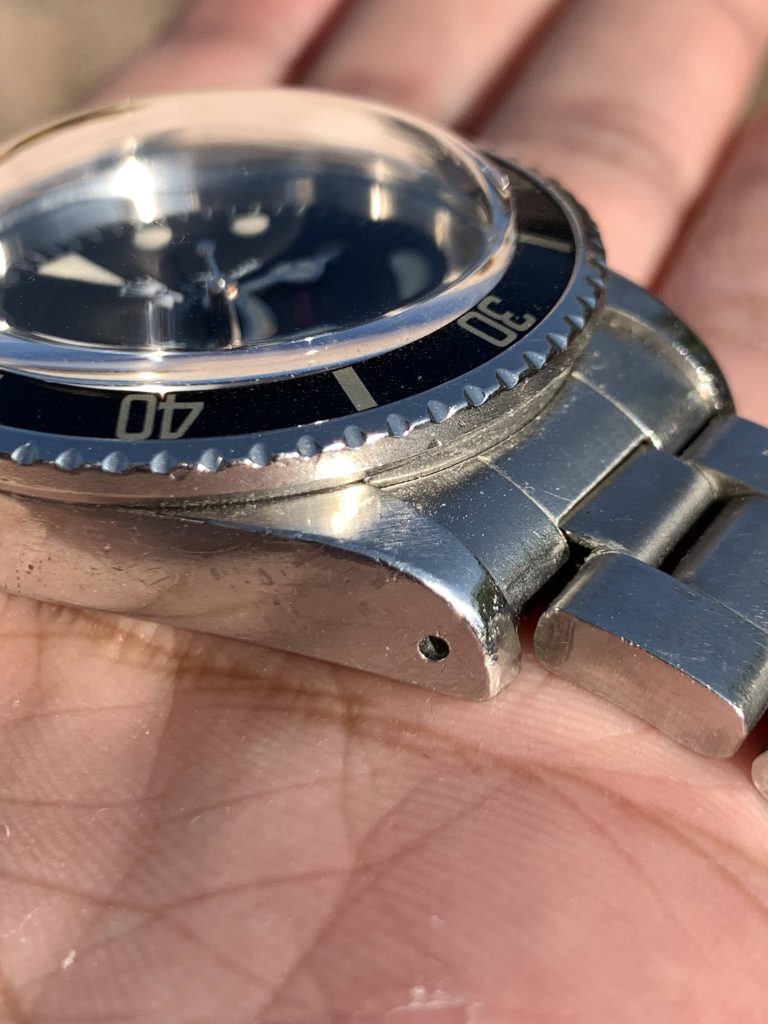
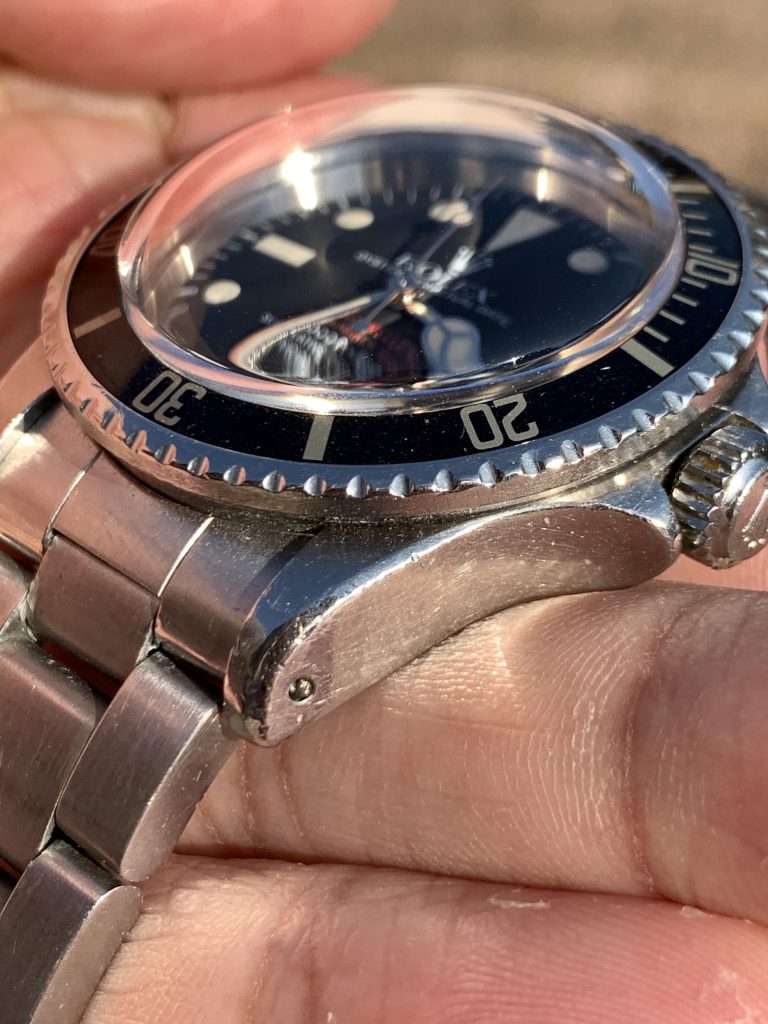
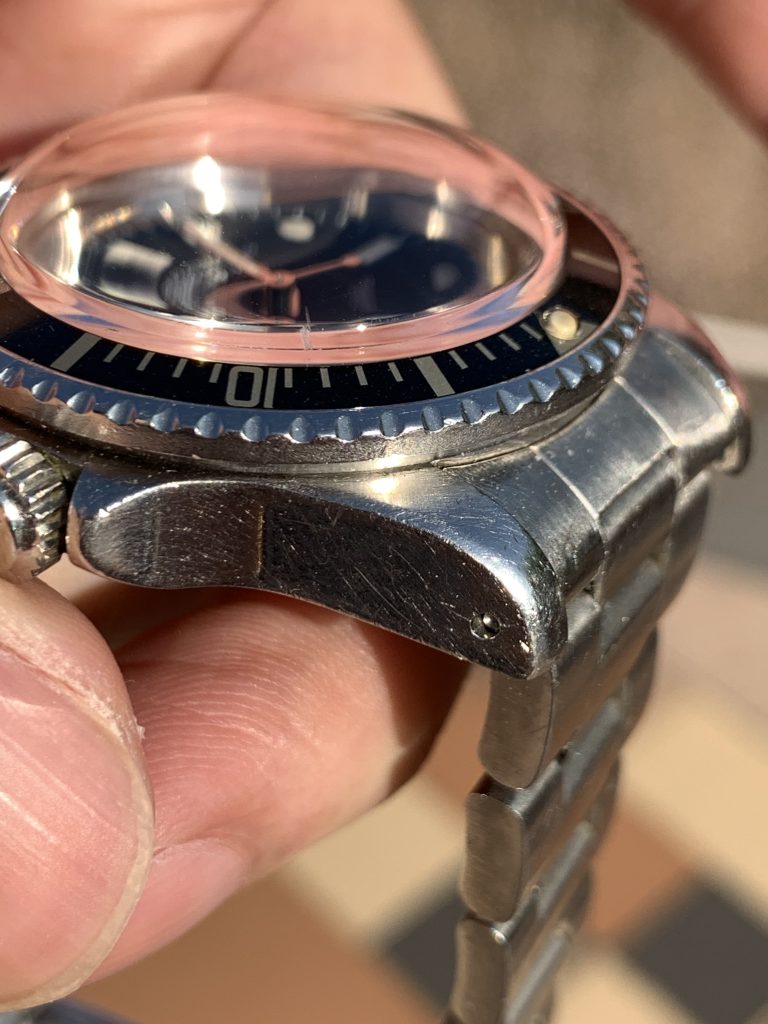
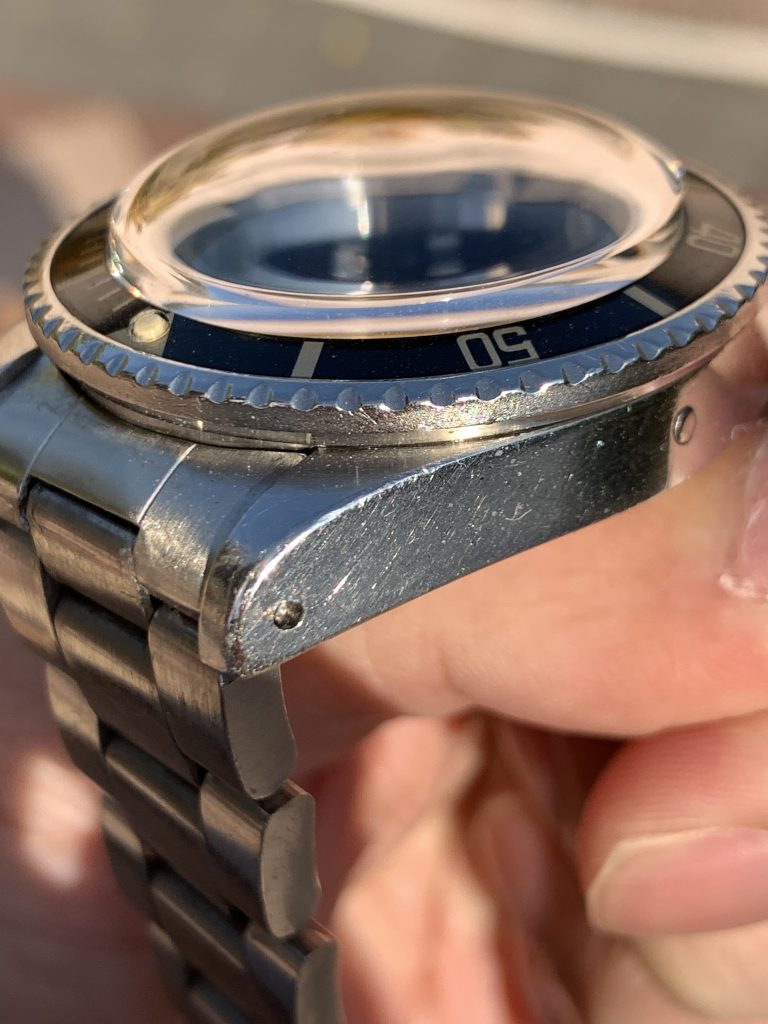
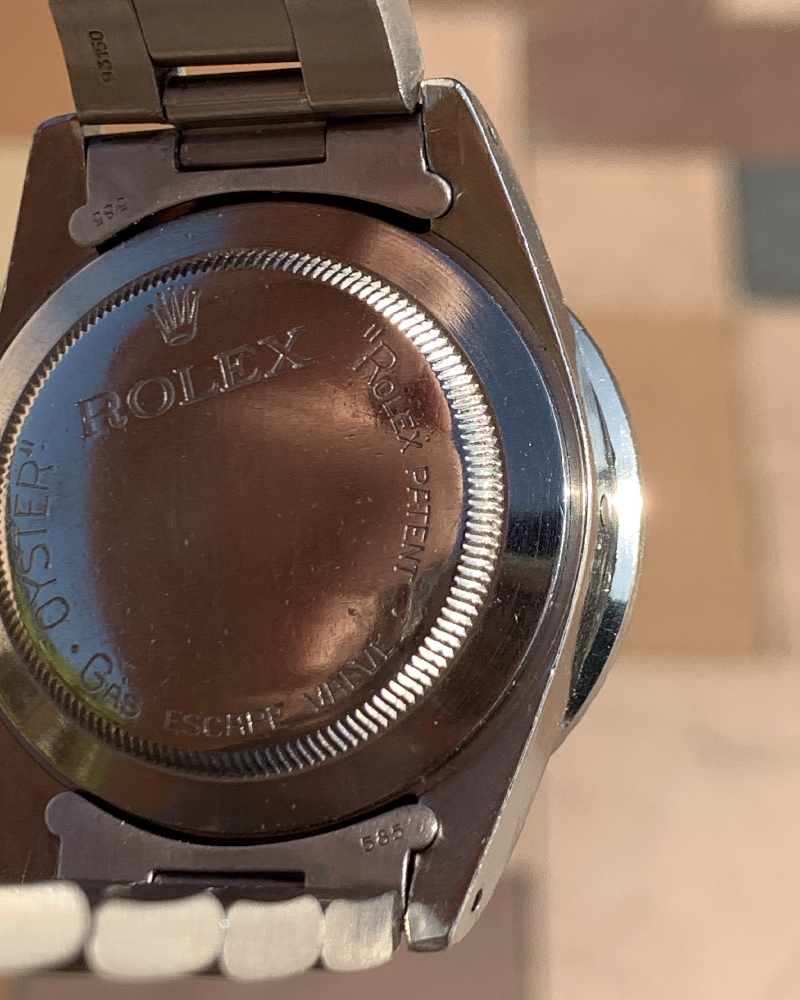
First, the case has to be unpolished. In an unpolished case, the lug holes are razor sharp in a natural way. There should be ample distance between the holes and the edges on the case. The bevels should be thick and sharp, and the edges should also be razor sharp. On the back side of the case, I look for a razor sharp edge around the non crown guard side of the case. That edge should be very thick and rise above the metal around the caseback area. The same sharp edge should be found around the crown guard side, just that the edge may not rise up so much like the other side. The crown guard on an unpolished case should be beefy but not rounded. There should be a slight step on the surface of the crown guard (this is hard to come by as that step can be easily erased by sleeve polish) The overall case size should be beefy as well.
On the dial, there should not be any missing minute marker. More often than not, the 60, 45 and 30 minute marker can be found partly missing due to poor technique in repair and assembling . The dial has to be free of marks and stains. The black paint of the maker should not show signs of having been redone (lighter color of the fonts is often a sign) The red fonts have to remain sharp and dot-like. The tritium lume has to be clean without black dots (often signs of moisture getting in) There should not be a big missing part in each lume plot. The edge of the dial is also important. There are stain or broken parts there very often. Therefore, I look for a clean edge around the dial that is free of damage. On the lume plots and the tritium on the hands, there should be tritium dust of two to three colors (red, green and orange) underr UV. Of course, the color of the hands has to match that of the lume plots. Always watch out for relumed hands which can be told by the texture and color of the tritium there.
The sharp edge on the back of the case
The bezel has to be the early type bezel which stands taller than later version. The insert has to be a MK3 fat font insert. Inserts with chips, cracks or a big area of loss of paint are not preferred. Loss of paint happens often on the edge. The bracelet has to be a 9315 with 380, 285, 385 endlinks. The 285 and 385 are rather hard and expensive to come by. After 1976, the bracelet should be 93150 with 585 endlinks.
It is uneasy for a DRSD to have all the perfect elements unless it is from the original owner or it has been very well taken care of. Very often, an unpolished case may come with a less desirable dial while a pumpkin dial may come with a poorer case. Hands may often have been replaced and the color may not match that of the lume. Therefore, if you come across an unpolished one with a clean dial and the hands match the lume, don’t miss it.